Daytime vs. Night Mangrove Boat Tour in Manuel Antonio: What’s the Difference?
Planning Your Quepos Mangrove Boat Tour
Whether you choose daytime or nighttime, it is worth checking a few details before booking your Quepos Costa Rica mangrove boat tour.
Ask the operator:
- Where does the tour depart?
- Is hotel transportation included?
- How long is the excursion?
- What time does it leave?
- Is the schedule affected by tides?
- Is food or a snack included?
- What wildlife is commonly seen?
- What should you bring?
- Are children allowed?
- What happens if weather conditions are poor?
Tour details vary between operators, so don’t assume that every mangrove tour includes the same services.
Some current excursions include transportation, a naturalist guide, refreshments, and a Costa Rican meal, while inclusions differ by tour.
Which One Should You Choose?
There isn’t one universal answer.
Choose a daytime mangrove boat tour Manuel Antonio Costa Rica if you want to see the mangrove forest in natural light, take photographs, watch birds, and enjoy a relaxed nature experience.
Choose a night tour if your main interest is nocturnal wildlife and you like the idea of exploring dark mangrove channels with a guide and spotlight.
If you are traveling with young children, consider whether they will enjoy being out after sunset.
If you are a wildlife enthusiast, the nighttime experience may appeal to you because the animal activity can be very different after dark.
And if you are visiting Manuel Antonio for several days, experiencing the mangroves during both periods can show you just how much an ecosystem changes between daylight and darkness.
Daytime vs. Night Mangrove Boat Tour: Quick Comparison
Daytime Tour
Best for:
- First-time visitors
- Families
- Photography
- Birdwatching
- Scenic views
- Comfortable wildlife observation
Main advantages:
- Natural light
- Easier photography
- Good visibility
- Comfortable sightseeing
- Wildlife and scenery can be observed together
Night Tour
Best for:
- Wildlife enthusiasts
- Repeat visitors
- Adventure seekers
- People interested in nocturnal animals
- Travelers looking for a different experience
Main advantages:
- Nocturnal wildlife
- Unique atmosphere
- Spotlight wildlife viewing
- Cooler conditions after sunset
- A completely different perspective of the mangroves
Can You See Crocodiles During the Day?
Yes.
Crocodiles and other reptiles can potentially be seen during daytime mangrove tours.
However, nighttime tours may offer a different way of locating them because guides can use lights to search the dark water for reflective eyes.
Current tour descriptions for both day and night excursions mention crocodiles among the possible wildlife sightings.
So you should not assume that a daytime tour means you will miss all reptiles.
The difference is more about the overall wildlife-viewing conditions and atmosphere.
Can You Do Both?
If you have enough time in your Costa Rica itinerary, you could experience the mangroves during both day and night.
The two tours offer different perspectives.
A daytime trip lets you appreciate the landscape, vegetation, birds, and animals in natural light.
A nighttime excursion gives you the opportunity to explore the same type of ecosystem after sunset and search for nocturnal wildlife.
For most travelers, however, one tour is enough.
If you’re particularly interested in wildlife or photography, doing both can provide a more complete picture of the mangrove ecosystem.
Is a Night Mangrove Tour More Adventurous?
For many visitors, yes—but the adventure comes from the atmosphere rather than physical difficulty.
A night boat tour does not usually require strenuous activity.
You sit in the boat while the guide navigates the channels and searches for animals.
The sense of adventure comes from not knowing what you might see next.
During the day, you can easily look around and see the landscape.
At night, your attention becomes focused on a smaller area illuminated by the guide’s light.
A branch moves.
The guide points.
Everyone looks.
Suddenly, a frog, snake, crocodile, or other animal appears in the beam.
That anticipation is a major part of the nighttime experience.
Tides Can Affect Your Tour Time
One detail travelers sometimes overlook is that mangrove tours operate in a tidal environment.
The Damas estuary is connected to coastal waters, and tour schedules can therefore be influenced by tides.
Some operators publish specific departure times designed around tide conditions rather than offering completely flexible departures.
This means your preferred time may not always be available.
If you specifically want a morning daytime tour or an evening wildlife experience, check the schedule when making your reservation.
Your operator can tell you the appropriate departure time for the date of your visit.
What About the Weather?
Weather is another consideration.
Manuel Antonio and Quepos have a tropical climate, and conditions can change.
Daytime tours expose you to more direct sunlight and heat, especially around midday.
An early morning tour can be more comfortable if you prefer cooler temperatures.
Night tours avoid the strongest daytime heat, but rain can still occur.
A rainy evening can change the atmosphere of a night tour considerably.
Rather than assuming one time of day is always better, check the forecast and ask the tour operator about the expected conditions.
Daytime vs. Night: What Should You Wear?
There is some overlap between what you should bring for both experiences.
For a daytime tour, consider bringing:
- Lightweight clothing
- Sunscreen
- Hat
- Sunglasses
- Comfortable shoes
- Insect repellent
- Camera
- Water
- Waterproof bag
For a night tour, consider:
- Lightweight long-sleeved clothing
- Insect repellent
- Comfortable shoes
- Camera
- Water
- A light jacket or shirt
- Waterproof bag
Current local tour information commonly recommends insect repellent and a camera for night excursions.
The exact list will depend on your tour operator and the time of year.
Which Tour Is Better for Families?
For families with young children, a daytime Quepos Costa Rica mangrove boat tour may be easier to fit into a vacation schedule.
You can enjoy the wildlife and scenery without staying out after dark.
Daytime tours also make it easier for children to see the surroundings and understand what the guide is pointing out.
That does not mean children cannot enjoy a night tour.
Some operators accept children on their nighttime boat excursions, but parents should consider their child’s comfort with darkness, insects, late-evening travel, and being on a boat after sunset.
Always check the specific age requirements and schedule with your chosen tour operator.
Which Tour Is Better for Photography?
If photography is your priority, the daytime tour has some practical advantages.
Natural light makes it easier to photograph the scenery and animals without depending on artificial lighting.
The daytime tour is particularly useful if you want photographs of:
- Mangrove roots
- Birds
- Monkeys
- Reptiles
- Reflections
- The surrounding landscape
Night photography is more challenging.
You may be photographing animals illuminated by a flashlight or spotlight, and movement in low light can make getting a sharp photograph more difficult.
However, night tours can produce unique images that you simply cannot capture during the day.
A glowing pair of crocodile eyes on dark water or a frog sitting on a mangrove leaf can make a memorable photograph.
Daytime vs. Night Mangrove Tour: Wildlife
Wildlife is probably the biggest factor when choosing between the two.
During the day, visitors may have opportunities to see:
- White-faced capuchin monkeys
- Iguanas
- Herons
- Kingfishers
- Basilisks
- Crabs
- Crocodiles
- Sloths
- Snakes
- Other tropical birds
At night, the focus shifts toward species and behaviors that are easier to observe after dark.
Possible sightings include:
- Crocodiles or caimans
- Frogs
- Bats
- Snakes
- Owls and other nocturnal birds
- Crabs
- Nocturnal mammals
- Reptiles
Local tour operators specifically describe night excursions as opportunities to search for nocturnal species using lights while traveling through the Damas Island mangrove channels.
The important word is possible.
A responsible mangrove tour should never promise that you will see a specific animal.
Wildlife is wild, and every tour can be different.
Why Choose a Night Mangrove Tour?
The biggest reason to choose a night tour is the opportunity to observe the ecosystem after dark.
Nocturnal wildlife
Many animals change their behavior when the sun goes down.
Some species become active, while others settle into the trees or disappear from view.
Night tours can provide opportunities to look for frogs, bats, snakes, crocodiles, owls, and other nocturnal animals. Tour operators in the Manuel Antonio and Quepos area specifically market their night excursions around this after-dark wildlife activity.
Again, wildlife sightings are never guaranteed.
The guide’s knowledge, weather, tides, season, and natural animal behavior all influence what you see.
A different atmosphere
The feeling of traveling through the mangroves after sunset is completely different from being there in the morning.
The forest becomes darker.
Sounds become more noticeable.
The boat moves slowly through the channels while the guide searches with a flashlight.
For travelers who enjoy unusual nature experiences, this atmosphere can be one of the highlights of the excursion.
Spotlight wildlife viewing
Night tours commonly use lights to locate animals along the banks and in the trees.
A guide may sweep a light across the water and vegetation, looking for the reflection of an animal’s eyes or movement in the branches.
This creates an interactive element because everyone on the boat is looking and trying to spot the next animal.
What Is a Night Mangrove Boat Tour Like?
A night mangrove tour is not simply the daytime tour performed later.
The entire atmosphere changes.
As daylight disappears, the mangrove channels become darker and quieter. Guides use lights to search the vegetation and water for nocturnal wildlife.
Current night-tour descriptions highlight animals such as crocodiles, boas, bats, frogs, nocturnal birds, crabs, and other creatures that may be more active after dark.
Instead of spending most of your time looking at the scenery, you may find yourself scanning the darkness for a pair of reflective eyes or movement among the roots.
That makes the experience feel more like a wildlife safari.
Why Choose a Daytime Mangrove Tour?
A daytime mangrove boat tour Manuel Antonio Costa Rica experience can be a good choice if you want to appreciate the ecosystem itself.
Better natural light
Photography is generally easier during daylight.
You can photograph the mangrove trees, reflections on the water, birds in the branches, and other wildlife without relying primarily on a flashlight or spotlight.
If photography is one of your main reasons for taking the tour, daytime can provide more opportunities to capture the overall landscape.
Easier wildlife observation
Many animals are active during daylight hours, including numerous birds and some of the mammals and reptiles found around the mangroves.
Your guide may stop or slow the boat when an animal is spotted.
The natural light also makes it easier to see the details of an animal once it has been located.
Scenic views
The daytime experience is not only about wildlife.
The mangrove forest itself is part of the attraction.
You can see the roots extending into the water, narrow channels opening into wider areas, and sunlight filtering through the vegetation.
The scenery changes as the boat moves through different parts of the estuary.
Comfortable for families
Daytime boat tours can be a practical choice for families who want a nature activity without adding a late-night excursion to their schedule.
Current tour operators advertise daytime and nighttime mangrove boat tours for a wide range of visitors, with boat tours requiring minimal physical activity.
What Is a Daytime Mangrove Boat Tour Like?
A daytime mangrove tour is generally a relaxed wildlife and nature experience.
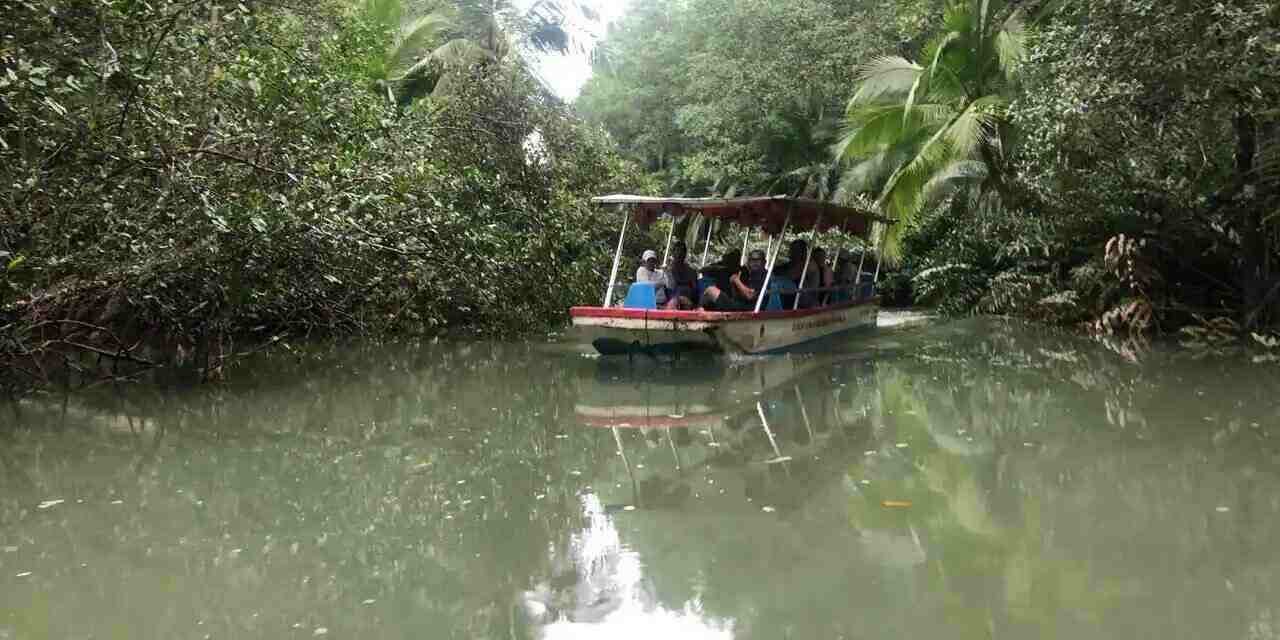
You board a motorized boat and travel through the mangrove channels while a guide looks for wildlife and explains the ecosystem.
The boat allows you to cover more water than you could comfortably explore on foot. It also provides an easy way to observe the vegetation along the banks and look upward into the trees.
During daylight hours, guides may search for animals such as monkeys, iguanas, birds, crocodiles, basilisks, crabs, snakes, and sloths. Sightings vary, however, and there is no guarantee that you will see a particular species on any individual tour.
One of the biggest advantages of a daytime tour is visibility.
You can see the mangrove roots, waterways, tree canopies, birds, and surrounding landscape without relying on artificial lights.
For many travelers, this makes the daytime tour feel more like a combination of sightseeing and wildlife watching.
Where Do Manuel Antonio Mangrove Boat Tours Take Place?
Many tours marketed as Manuel Antonio mangrove tours actually explore the mangrove ecosystem around Damas Island, near Quepos.
Damas Island is separate from Manuel Antonio National Park. Instead of hiking through rainforest trails, you travel by boat through calm waterways surrounded by mangrove trees.
The area is close enough to Manuel Antonio that it is commonly included in excursions for travelers staying in Manuel Antonio and Quepos.
Depending on the operator, transportation from your hotel may be available. Some tours depart directly from the Damas estuary, while others include round-trip transportation from hotels in the Manuel Antonio and Quepos areas.
This means that when searching for a Quepos Costa Rica mangrove boat tour, you may see the same Damas Island ecosystem described under several different names.
You may find tours advertised as:
- Manuel Antonio mangrove tour
- Damas Island mangrove tour
- Quepos mangrove tour
- Mangrove boat tour Manuel Antonio
- Quepos Costa Rica mangrove boat tour
- Manuel Antonio wildlife boat tour
The destination and experience can overlap even when the marketing name is different.
If you are planning a nature adventure in Costa Rica, a mangrove boat tour near Manuel Antonio is an excellent way to experience a side of the region that is very different from the beaches and rainforest trails.
The mangroves around Damas Island, near Quepos, are made up of calm tidal channels surrounded by dense vegetation. They provide habitat for birds, reptiles, mammals, fish, and many other species. Visitors can explore this ecosystem by boat during the day or return after sunset for a completely different wildlife experience.
So, which is better: a daytime mangrove boat tour in Manuel Antonio Costa Rica or a night tour?
The answer depends on what you want to see and how you want to experience the mangrove ecosystem.
Daytime tours generally provide better natural light, scenic views, birdwatching opportunities, and comfortable conditions for observing the mangrove landscape. Night tours create a more adventurous atmosphere and focus on animals that become active after dark, often using flashlights or spotlights to search along the water and vegetation. Current local tour operators offer both daytime and nighttime boat excursions through the Damas Island mangroves.
Here’s what you should know before choosing.